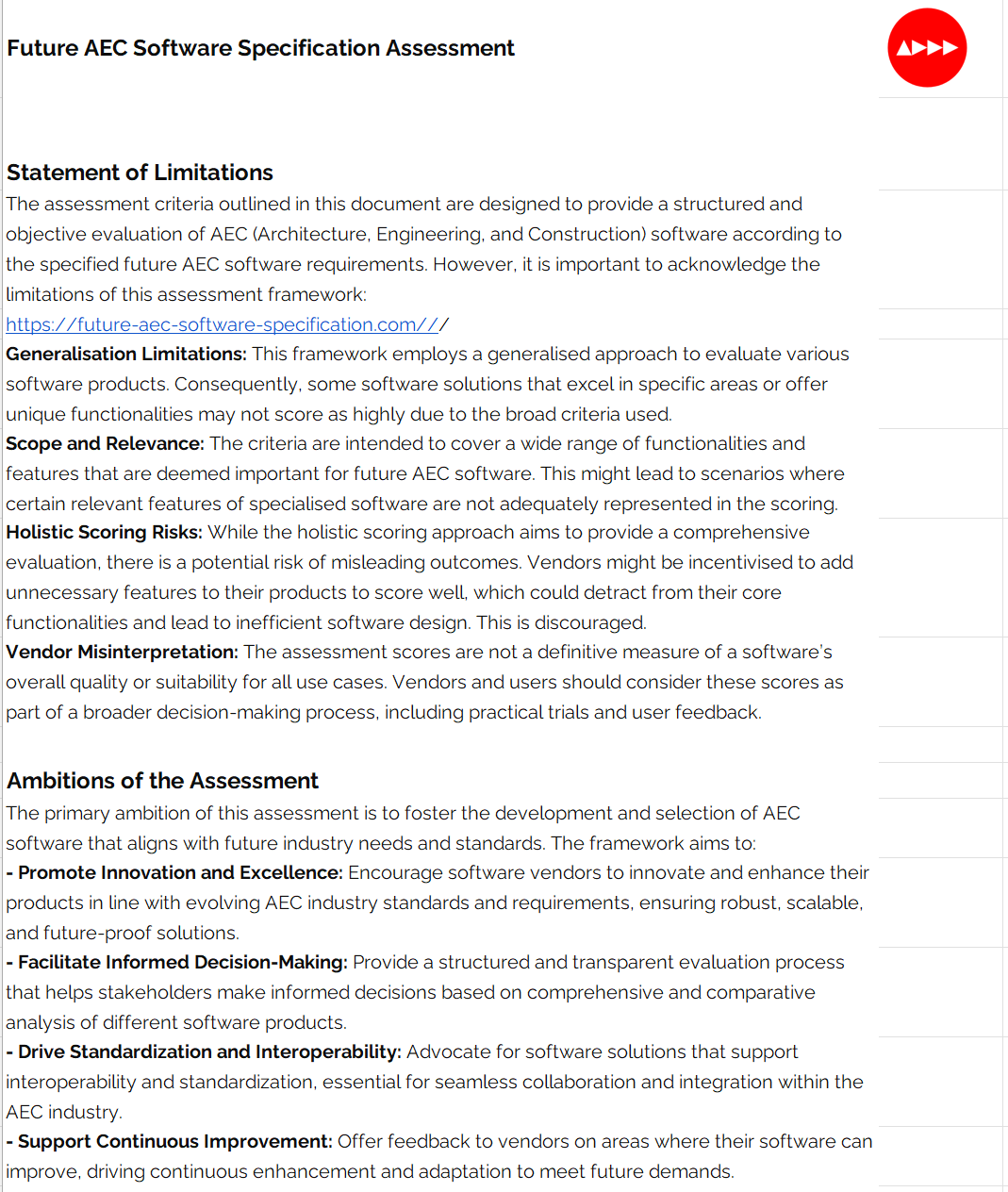
The Future AEC Software Specification (FASS) Assessment provides a structured framework for evaluating AEC software solutions across several key criteria, ensuring that the tools selected meet the diverse needs of Architecture, Engineering, and Construction professionals. This is a first for the AEC industry and aims to provide a consistent benchmarking system for assessing software. This is provided in Excel format for ease of use to download and start using.Here’s a summary of the criteria used in the assessment:
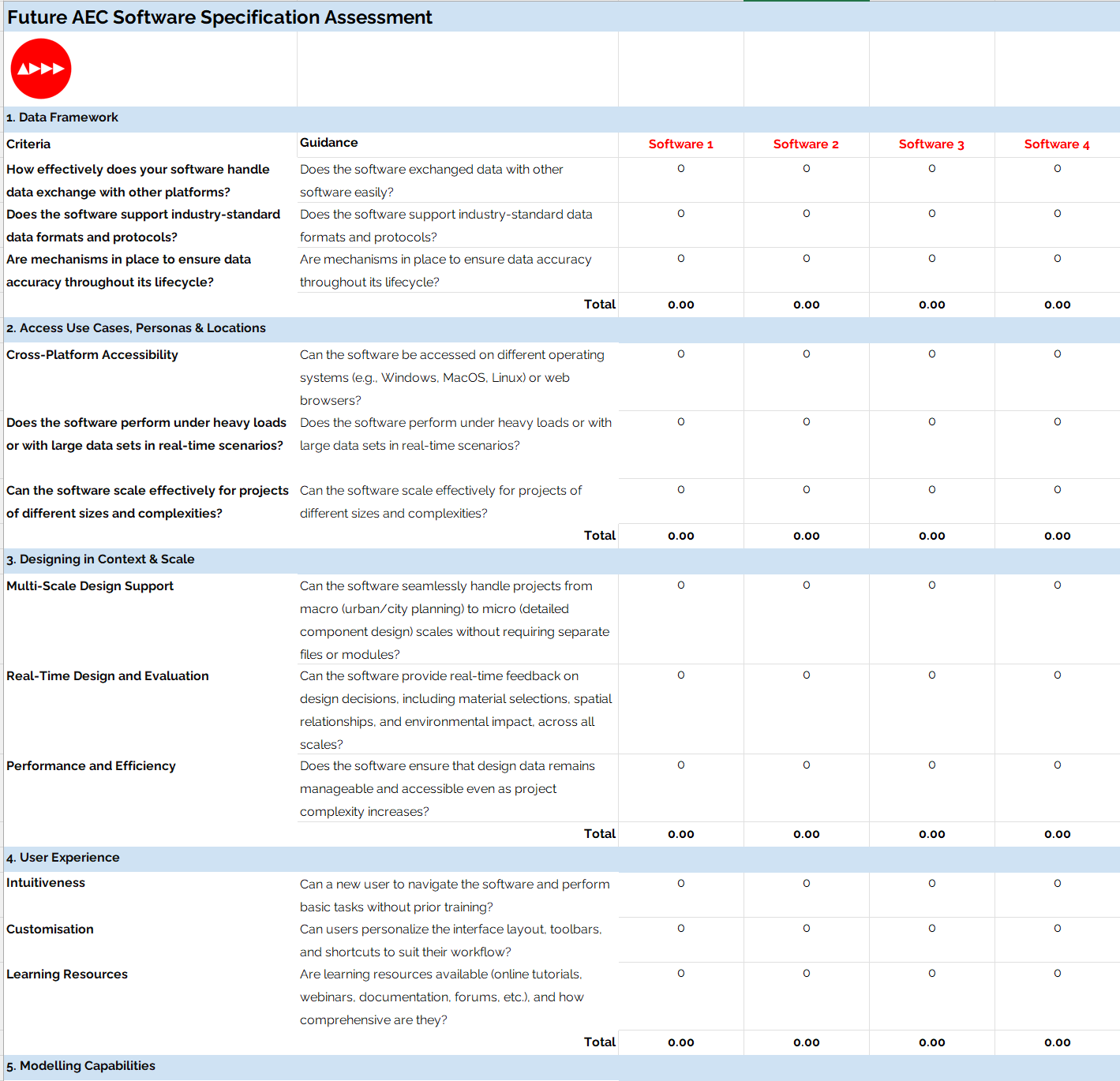
1. Data Framework
Data Exchange: How effectively the software integrates and exchanges data with other platforms, ensuring seamless workflows.
Data Accuracy: Mechanisms in place to ensure that data is accurate and remains consistent across various systems.
File Compatibility: Support for industry-standard data formats like IFC, BCF, and IDS.
2. Access, Use Cases, Personas, and Locations
Cross-Platform Accessibility: The software’s ability to work across different operating systems (e.g., Windows, MacOS) and web browsers.
Real-Time Performance: The software’s ability to handle large data sets or complex models in real-time.
Scalability: How well the software can scale for projects of varying sizes and complexities.
3. User Experience
Ease of Use: How intuitive the software is for new users, including the availability of user-friendly features and customizable interfaces.
Learning Resources: Availability and quality of learning resources (tutorials, webinars, documentation).
Customization: Ability for users to personalize the software interface, toolbars, and shortcuts to fit their workflow.
4. Automation & Intelligence
Task Automation: The extent to which the software automates repetitive tasks, such as clash detection or issue tracking.
AI-Assisted Insights: How the software uses artificial intelligence to provide design insights, optimization suggestions, and performance analysis.
User Control: How much control users have over automated processes and AI-driven insights.
5. Deliverables
Automated Documentation: How well the software produces accurate and customizable reports, drawings, and other project deliverables automatically.
Speed of Deliverables: Time saved by automating the generation of deliverables compared to manual processes.
Adaptability: The software’s ability to tailor deliverables to meet specific project or client requirements.
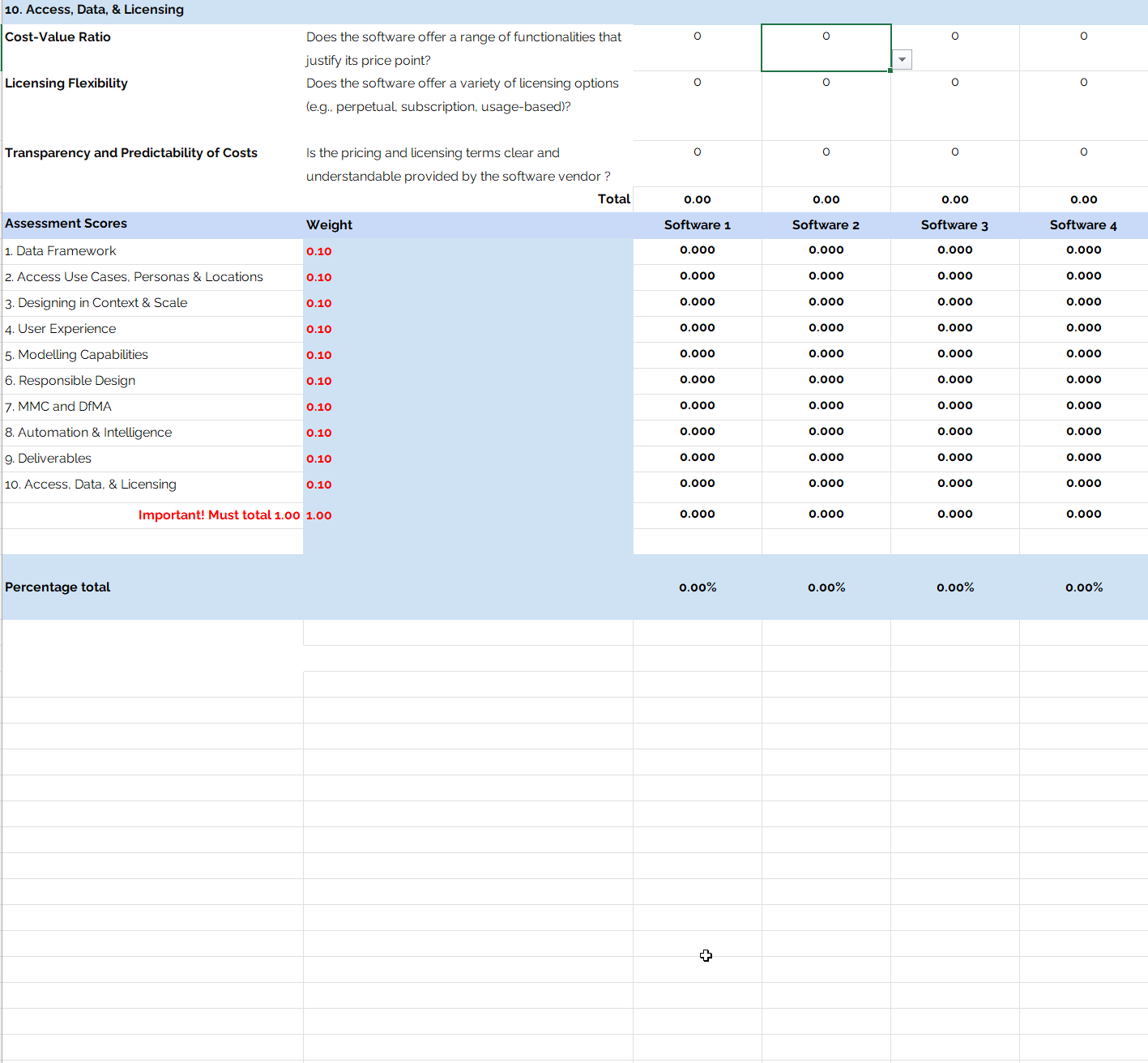
6. Access, Data, and Licensing
Cost-Value Ratio: Whether the software’s features justify its pricing structure.
Licensing Flexibility: Variety and flexibility in licensing options (e.g., subscription, perpetual licenses).
Cost Transparency: Clarity in pricing and licensing terms, ensuring no hidden costs or complex billing structures.
7. Integration Capabilities
Tool Integration: How well the software integrates with other popular AEC tools (e.g., Revit, Navisworks, Procore).
Data Sharing: The ease of sharing and collaborating on data between different stakeholders and teams using the software.
8. Clash Detection and Coordination
Detection Accuracy: The software’s ability to detect clashes or issues in models with high precision.
Coordination Features: Tools that facilitate collaboration between teams, enabling them to resolve issues and track progress efficiently.
Reporting: The ability to produce reports and track issues through a clear, accessible system.
9. Support and Customer Service
Customer Support Quality: The availability of support resources, including help centers, forums, and direct customer service channels.
Training: Access to training materials, online courses, and onboarding support for new users.
10. Implementation and Updates
Implementation Speed: How quickly the software can be deployed and integrated into existing workflows.
Software Updates: Frequency and quality of updates, ensuring the software remains relevant and efficient as the industry evolves.
By applying these criteria, the FASS Assessment offers a comprehensive, objective way to evaluate AEC software tools. It helps firms select software that best aligns with their specific project needs, ensuring efficiency, ease of use, and cost-effectiveness across all stages of their workflow. This framework is ideal for firms looking to improve collaboration, reduce errors, and streamline operations in an increasingly digital construction environment.